

West Highland Way Scotland: What It’s Really Like to Hike the Famous 96-Mile Trail
The West Highland Way is Scotland’s most popular long-distance hiking trail, stretching 96 miles (155 km) from Milngavie near Glasgow to Fort William in the Scottish Highlands. This iconic route takes walkers through some of Scotland’s most spectacular landscapes, from peaceful lochs and rolling moors to dramatic mountain scenery and historic villages.
Listen to two podcast episodes about hiking Scotland’s most famous trail.
In the first episode, Kit shares her personal West Highland Way adventure — including the breathtaking views, charming villages along the route, and a few unexpected mishaps. She describes walking beside the stunning shores of Loch Lomond, crossing wild Highland moorland, and traveling from one historic village to another. Most hikers complete the trail in 5–10 days, depending on pace and itinerary.
In the second episode, Phil explains how he and his wife used the West Highland Way as their “test” long-distance hike before attempting the Camino de Santiago, making this route an excellent choice for first-time multi-day trekkers.
Along the West Highland Way, hikers encounter:
-
Historic castle ruins and monuments
-
Classic Highland scenery with grazing sheep and cattle
-
Traditional Scottish inns such as the Drymen Inn and the Drovers Inn
-
Beautiful villages including Rowardennan, Inverarnan, and Kinlochleven
-
Dramatic fjord-like mountain landscapes surrounding Kinlochleven
These two episodes give you two real-world perspectives on what it’s like to hike the West Highland Way — and why this classic Scottish trek deserves a spot on your adventure travel bucket list.
👉 Download both episodes to start planning your West Highland Way adventure.
Listen to the podcasts here:
Kit's interview of Phil about his adventures on the West Highland Way:
Kit talks about her own long distance walk of the West Highland Way:


Where Does the West Highland Way Start? (Getting to the Trailhead)
The West Highland Way begins in Milngavie, a small town about 10 miles (16 km) northwest of Glasgow, Scotland.
Most hikers reach the trailhead by taking public transportation from Glasgow, which is quick and easy. If you prefer a more scenic start, you can also walk to Milngavie from central Glasgow via the Kelvin Walkway — a pleasant route that lets you ease into your hike before the official trail begins.
If you’re arriving from overseas, it’s smart to spend one or two days in Glasgow first to recover from jet lag and prepare for your trek. Glasgow is a lively, affordable city known for its friendly locals, vibrant music scene, and cultural attractions.
One of the city’s most famous quirky traditions is the statue outside the Gallery of Modern Art, where locals repeatedly place a traffic cone on the statue’s head — despite authorities regularly removing it. Many residents jokingly consider the cone part of the artwork itself.
Who Can Hike the West Highland Way?
The West Highland Way is suitable for most reasonably fit walkers, especially if you do some basic training beforehand.
While the trail includes a few longer climbs and descents, the mountains are not extremely high, and the path is well established. Most hikers complete the route comfortably by pacing themselves and allowing enough days for the journey.
The trail is also popular with:
-
First-time multi-day hikers
-
Camino pilgrims looking for a training trek
-
Active travelers seeking a classic Scottish long-distance walk
In many sections, the West Highland Way can also be completed by mountain bike, making it a flexible adventure for different fitness levels and travel styles.
You walk through mostly VERY small villages that do NOT have many places to sleep, so it is imperative that you plan and book your accommodations ahead of time. I recommend my affliliate One Foot Abroad. Email me for an exclusive discount promo code.


How Hard Is the West Highland Way? (Difficulty Explained)
The West Highland Way is generally rated a moderate (3 out of 5) difficulty hike, mainly due to its total length of 96 miles (155 km) rather than extreme elevation or technical terrain.
Most of the trail follows well-marked paths, but a few sections can feel more challenging:
-
The stretch along Loch Lomond toward Inverarnan includes rocky scrambles and uneven stone steps that can be tough on the knees.
-
The famous Devil’s Staircase is steep but short and manageable at a steady pace.
-
Some stages involve long walking days, especially if accommodations are fully booked.
To make the hike easier, consider taking the “high road” option above Loch Lomond, which many walkers find simpler than the lower lakeside path. Local advice or your accommodation host can point you in the right direction.
Because lodging along the West Highland Way is limited, booking early gives you more flexibility to adjust daily distances. Many hikers enjoy the experience more by planning shorter mileage days over more total days, leaving energy to explore the villages and inns along the route.
Can You Walk the West Highland Way Solo?
Yes — the West Highland Way is one of the best long-distance trails in Europe for solo hikers.
Many people walk the route alone and quickly meet fellow travelers along the trail, often forming friendships that last well beyond the trip.
One particularly remote section runs between Bridge of Orchy and Kingshouse, where services are extremely limited for many miles. Because this area is exposed and sparsely populated, it’s wise to:
-
Walk near other hikers when possible
-
Check weather forecasts carefully
-
Carry appropriate rain and safety gear
If conditions are poor, you can also take a public bus to bypass this section, which is what some hikers choose to do during severe weather. That's what I had to do on my own West Highland Way adventure due to seriously frigid, biting rain (you can listen to my story HERE).


Guided vs Self-Guided West Highland Way: Tours, Costs & How to Choose
Yes — you can hike the West Highland Way either guided or self-guided, depending on your travel style and experience level.
Self-Guided West Highland Way (Most Popular Option)
Many walkers choose a self-guided hike, which means a tour company handles the logistics while you walk independently.
Typically, a self-guided package includes:
-
Custom daily itinerary based on your preferred pace
-
Pre-booked accommodations along the trail
-
Daily luggage transfer between lodgings
-
Maps, route notes, and emergency support
This option lets you enjoy the freedom of hiking solo while avoiding the stress of planning and carrying a heavy pack. Even when walking independently, it’s easy to meet other hikers along the trail and share sections together.
Fully Guided West Highland Way Walks
If you prefer more structure, you can also join a small guided group tour.
A guided trip typically includes:
-
Professional hiking guide
-
Fixed group itinerary
-
Built-in social experience
-
Extra navigation and safety support
This is a great choice for first-time long-distance hikers or travelers who prefer constant company.
Is the West Highland Way Well Marked and Safe?
Yes — the West Highland Way is extremely well marked and considered very safe for walkers.
The trail uses the iconic thistle trail marker, which appears at key junctions and decision points. In most places, the path itself is very obvious and easy to follow.
Much of the route follows historic travel corridors, including:
-
Old military roads
-
Traditional trade routes
-
Historic drovers’ paths once used to move livestock
Because of this, the trail generally has a steady, manageable gradient rather than extreme mountain scrambling.
Safety on the West Highland Way
Most hikers report feeling very safe on the trail (which was my own experience).
-
Scottish locals are famously friendly and helpful
-
Fellow walkers are common, especially during peak season
-
Emergency access exists at multiple road crossings
For many travelers, the West Highland Way is considered one of the best first solo long-distance hikes in Europe, making it an excellent introduction to independent adventure travel.
Where to Stay on the West Highland Way (Best Towns by Stage)
Accommodation along the West Highland Way is located in small villages and historic inns spaced along the 96-mile (155 km) route from Milngavie to Fort William. Because lodging options can fill up quickly (especially May–September), most hikers plan their daily stages based on where overnight stays are available.
Here are the most popular overnight stops, listed in walking order.
Milngavie (Trail Start)
Distance from Glasgow: ~10 miles
Milngavie is the official starting point of the West Highland Way and an easy suburb of Glasgow to reach by train. Many walkers stay here the night before beginning the trail so they can start fresh in the morning.
You’ll find:
-
Small hotels and guesthouses
-
Restaurants and grocery stores
-
The famous West Highland Way starting monument
Note that I actually WALKED to Milngavie from Glasgow on the Kelvin Path (around 10 miles/17 km).
Drymen
Best for: First-night stop for most hikers
Drymen is the first classic overnight village on the trail and home to the historic Drymen Inn, one of the best-known hiking pubs on the route.
Expect:
-
Cozy inns and B&Bs (The Dryman Inn claims to be the oldest in Scotland)
-
Traditional Scottish pub atmosphere
-
Easy access to the Conic Hill section the next morning
Rowardennan / Loch Lomond Area
Best for: Lakeside scenery
Rowardennan sits directly on the shores of Loch Lomond and is one of the most scenic overnight stops on the entire trail.
Good to know:
-
Lodging here is limited — book early
-
Stunning sunset views over the loch
-
Start of the more rugged Loch Lomond walking section
- Consider staying an extra day here!
Inverarnan
Inverarnan is famous for the legendary Drovers Inn, a historic Highland pub dating back centuries and a favorite stop for hikers.
Highlights:
-
Atmospheric historic lodging (in the older building)
-
Classic Highland pub food and shall we say, an interesting decor???
-
Convenient stopping point after the rocky Loch Lomond section
Bridge of Orchy
Bridge of Orchy is a tiny but beautiful Highland stop surrounded by mountains and open moorland.
Expect:
-
Limited but comfortable lodging
-
Peaceful remote setting
-
Gateway to the dramatic Rannoch Moor landscape
- Double check the weather before walking in this section!
Kingshouse / Glencoe Area
The Kingshouse area sits near the edge of Glencoe and offers some of the most spectacular scenery on the West Highland Way.
This section is remote, so:
-
Lodging choices are limited
-
Weather exposure can be significant
-
Many hikers plan carefully for this stage
- Double check the weather before walking in this section!
Kinlochleven
Kinlochleven is a charming Highland village surrounded by steep, fjord-like mountains and is a very popular last-night stop.
You’ll find:
-
Good range of hotels and guesthouses
-
Restaurants and resupply options
-
Stunning scenery before tackling the Devil’s Staircase section
Fort William (Trail Finish)
Fort William marks the official end of the West Highland Way beneath the shadow of Ben Nevis, the UK’s highest mountain.
Most hikers:
-
Stay at least one night to celebrate
-
Enjoy restaurants and pubs
-
Take transport onward to Glasgow or elsewhere
- Consider climbing Ben Nevis, Scotland's highest mountain. Check the weather first!
West Highland Way Accommodation Tips (Important for Planning)
-
Book 3–6 months ahead for peak season
-
Luggage transfer services are widely available
-
Many hikers prefer 7–9 days for a comfortable pace
-
Self-guided companies often secure the best room availability. I nrecommend my affiliate One Foot Abroad. Email me for an exclusive Promo Code.
Because villages are small and spaced apart, your lodging choices often determine your daily hiking distances.
West Highland Way Itinerary (Stage-by-Stage Walking Plan)
One of the easiest ways to plan your trek is to follow a professionally designed itinerary like the self-guided West Highland Way tour offered by One Foot Abroad. Their route follows the classic south-to-north journey from Milngavie to Fort William, with accommodations, luggage transfer, and logistics arranged in advance (Email me for an exclusive discount code).
This approach lets you focus on enjoying the hike while avoiding the stress of booking small village lodgings along the trail.
Day 1 — Arrive in Milngavie
Arrive in Milngavie, the official starting point of the West Highland Way, located just outside Glasgow. Most walkers stay overnight here to organize gear, buy snacks, and begin fresh the next morning.
Day 2 — Milngavie → Drymen (~12 miles / 19 km)
The trail begins at the famous West Highland Way monument and follows gentle countryside paths, riverside tracks, and woodland routes. This is one of the easier walking days and a great warm-up for the journey ahead.
Overnight in Drymen, a charming village known for its welcoming inns and traditional Scottish pubs.
Day 3 — Drymen → Rowardennan (~14 miles / 23 km)
Today includes the optional climb over Conic Hill, one of the first spectacular viewpoints of Loch Lomond. After descending, the trail continues toward the peaceful lakeside settlement of Rowardennan.
This is often considered one of the most scenic early stages of the entire hike.
Day 4 — Rowardennan → Inverarnan / Crianlarich Area
This section follows the rugged shoreline of Loch Lomond and includes some rocky terrain and uneven steps. It’s slower walking than previous days but extremely beautiful.
Many hikers stay near Inverarnan, home of the historic Drovers Inn.
Day 5 — Inverarnan → Bridge of Orchy Area
The trail leaves Loch Lomond and enters the wider Highland landscape, passing through open glens and historic military roads. Expect quieter scenery and expansive views.
Bridge of Orchy provides a peaceful overnight stop surrounded by mountains.
Day 6 — Bridge of Orchy → Kingshouse / Glencoe Area
One of the most dramatic days on the trail, crossing the wild expanse of Rannoch Moor before reaching the spectacular Glencoe region.
Because this is a remote section, many hikers appreciate having accommodations arranged in advance.
Day 7 — Kingshouse → Kinlochleven (via Devil’s Staircase)
Today includes the famous Devil’s Staircase, the highest point on the West Highland Way. Although steep, the climb is short and rewards hikers with outstanding Highland views.
Descend into Kinlochleven, a lively village and popular final overnight stop.
Day 8 — Kinlochleven → Fort William (Finish)
The final day crosses forest tracks and mountain scenery before descending into Fort William beneath Ben Nevis, the UK’s highest mountain.
Most hikers celebrate their finish with dinner in town and stay at least one night.
Why Many Hikers Choose a Self-Guided West Highland Way Tour
Following a structured itinerary helps because:
-
Accommodation along the trail is limited and books early
-
Daily distances are optimized for comfort and enjoyment
-
Luggage transfer allows you to hike with only a daypack
-
Emergency support is available if needed
If you want the convenience of pre-arranged lodging and logistics while still walking independently, a self-guided itinerary like those offered by One Foot Abroad can make planning much easier. Email me for an exclusive Promo Code.
How Much Does It Cost to Hike the West Highland Way? (2026 Budget Guide)
The total cost to hike the West Highland Way can vary widely depending on whether you plan the trip yourself, book a self-guided package, or join a fully guided tour.
Most hikers spend anywhere from $900 to $2,800+ per person for the full walk (excluding international flights). Below is a realistic breakdown to help you plan your budget.
Budget Option: DIY West Highland Way (£60–£110 / $75–$140 per day)
Planning the trip yourself is the cheapest option, but requires booking small village accommodations individually.
Typical daily costs:
-
Budget B&B or hostel: £45–£80
- Note that while in most of Scotland you are allowed to camp on private property (dusk to dawn), you are NOT ALLOWED to along Loch Lommond.
-
Meals and snacks: £20–£30
-
Occasional luggage transfer: £15–£25
-
Local transport / extras: £5–£10
Estimated 8-day total:
👉 £500–£900 ($650–$1,150)
Best for:
-
Experienced independent travelers
-
Flexible planners
-
Budget-conscious hikers
Most Popular Option: Self-Guided West Highland Way Tour (£150–£260 / $190–$330 per day)
A self-guided walking tour is the most common choice for first-time long-distance hikers because it removes the hardest logistics while keeping the freedom of walking independently. Consider One Foot Abroad and be sure to email me for an exclusive discount!
Typical inclusions:
-
All accommodations pre-booked (and usually a better selection than you can book)
-
Daily luggage transfers
-
Route maps and navigation support
-
Emergency assistance hotline
-
Breakfast included
Estimated 8-day total:
👉 £1,200–£2,000 ($1,500–$2,500)
This is the category where companies like One Foot Abroad specialize — arranging the entire itinerary while you simply walk with a daypack.
Best for:
-
First multi-day hikers
-
Solo travelers
-
Anyone wanting stress-free logistics
Premium Option: Fully Guided West Highland Way Tour (£260–£350+ / $330–$450+ per day)
Fully guided tours include a professional leader and group structure.
Typical inclusions:
-
Hiking guide
-
Group itinerary
-
Most meals included
-
Support coordination
Estimated 8-day total:
👉 £2,100–£3,000+ ($2,700–$3,800+)
Best for:
-
Travelers wanting constant guidance
-
Social group experiences
-
First-time international hiking trips
Extra Costs to Budget For
Even with a package, plan for:
-
Pub dinners and drinks: £18–£30 per night
-
Celebration meal in Fort William
-
Tips for luggage drivers (optional)
-
Last-minute gear purchases
A safe rule:
👉 Add £150–£300 extra spending money for the week.
Is the West Highland Way Worth the Cost?
For many hikers, the West Highland Way is one of the best-value long-distance walks in Europe because:
-
No trail permit is required
-
Public transport to the start is inexpensive
-
Luggage transfer services are widely available
-
Scotland allows flexible access rights for walkers
- Note that while in most of Scotland you are allowed to camp on private property (dusk to dawn), you are NOT ALLOWED to along Loch Lommond.
Compared with Alpine treks or guided pilgrimage routes, the West Highland Way often costs significantly less while offering equally dramatic scenery.

Best Time to Hike the West Highland Way (Weather by Month)
The best time to hike the West Highland Way is typically late May through early June, when days are long, temperatures are mild, and the worst of Scotland’s famous biting midges often haven’t fully arrived yet.
Early autumn (September–early October) is another excellent window, with cooler temperatures, fewer crowds, and beautiful Highland scenery.
West Highland Way Seasons Explained
🌼 Spring (April–May)
A popular time for local hikers. Expect:
-
Wildflowers beginning to bloom
-
Fewer crowds than summer
-
Cooler temperatures and occasional rain
-
Possible snow on higher sections early in the season
Spring can be beautiful but requires warm layers.
☀️ Early Summer (late May–early June) — BEST OVERALL
-
Long daylight hours
-
Pleasant walking temperatures
-
Green landscapes at their peak
-
Often before peak midge season
This is widely considered the sweet spot for hiking the West Highland Way.
🦟 Mid-Summer (late June–August)
-
Warmest weather of the year
-
Most popular tourist season
-
Peak accommodation demand
-
Arrival of Scotland’s notorious midges
Midges (tiny biting insects) typically appear sometime in June and can persist for several months. If hiking in summer, pack insect protection and consider a head net.
🍂 Autumn (September–October) — EXCELLENT ALTERNATIVE
-
Cooler hiking conditions
-
Dramatic Highland colors
-
Fewer walkers on the trail
-
Midges largely disappear
Many experienced hikers consider early autumn one of the best-kept secrets for walking the WHW.
❄️ Winter (November–March)
The West Highland Way is technically open year-round, but winter brings:
-
Very short daylight hours
-
Possible snow and ice
-
Limited accommodation availability
-
Challenging navigation in poor weather
Winter attempts are best suited for experienced cold-weather trekkers only, and I DO NOT RECOMMEND IT!
What to Pack for the West Highland Way (Essential Gear)
When hiking in Scotland, assume you may experience all four seasons in a single day — at any time of year.
Even in June or July, cold rain and strong wind are completely possible, especially in exposed Highland sections near Fort William.
West Highland Way Packing Essentials
Always carry in your daypack:
-
Waterproof rain jacket
-
Waterproof pants
- Waterproof gloves
-
Warm thermal layer or insulated jacket
-
Hat and waterproof gloves
-
Extra dry socks
If hiking in spring or autumn, consider adding:
-
Thermal leggings or insulated trousers
-
Heavier fleece or down jacket
-
Buff or warm neck layer
Weather in the Highlands can change rapidly. Many hikers experience cold, soaking rain even during summer months, so proper waterproof gear is essential for safety and comfort. ALWAYS check the weather each day before you head out, especially when crossing the moor!


The Clachan Inn is considered the UK's longest continously run pub! Stop by on your first night (northbound) in Drymen to have a pint and meet fellow hikers and locals!

One Foot Abroad
I recommend my affiliate, One Foot Abroad, to help you plan your West Highland Way adventure. They can plan all the logistics for you so all you have to do is train and show up to walk!
Based on your needs, they can tailor your average daily milage, accommodations, arrange for luggage transfer and will provide you with a map and guidebook, plus 24/7 assistance, if needed. They can also arrange for airport transfers. Email me for an exclusive Promo Code good on ANY One Foot Abroad (or their sister company, Follow the Camino for El Camino adventures).
You'll save money while helping to support the podcast and this website, plus helping to keep it ad free - thanks! Kit

Fort William
The terminus of the West Highland Way is Scotland's adventure capital, Fort William, and home of its tallest mountain, Ben Nevis. Allow a day or two to explore, and to relax and savor your accomplishment! You can take a stunning train ride to Maillag (even the historic steam train (Harry Potter's Hogwart Express) if you'd like!). Wander around, visit the museum, have lunch and head back. Beyond beautiful!

West Highland Way FAQs: ATMs, Dogs, Transport & Essential Trail Tips
Are There ATMs on the West Highland Way?
ATMs are limited along the West Highland Way, and many smaller villages either have no cash machine or only accept cash in local pubs, small shops, and taxis.
For this reason, it’s best to withdraw enough cash before starting your hike.
The safest places to get money are:
-
Glasgow
-
Milngavie (trail start)
-
Drymen
In the UK, many Post Offices allow debit card withdrawals, thanks to agreements with major banks. This can be helpful in villages without a traditional ATM.
Are Dogs Allowed on the West Highland Way?
Yes — dogs are allowed on the West Highland Way, but they must be kept on a leash, especially when crossing farmland or pasture.
This is extremely important because:
-
Sheep and cattle graze freely along many sections
-
Loose dogs can frighten or endanger livestock
-
Farmers take animal safety very seriously
Always clean up after your dog and check accommodation policies in advance, as many inns and guesthouses do notallow pets.
Do You Have to Walk the Entire West Highland Way?
No — you do not have to walk the entire West Highland Way. Many hikers choose to skip sections due to weather, injury, or time limits.
However, transportation between stages can be limited in some remote areas, so planning ahead is important.
West Highland Way Bus Access Between Major Stops
Public bus services connect several key villages along or near the route, including:
-
Milngavie → Drymen
-
Drymen → Balmaha
-
Inverarnan → Crianlarich
-
Crianlarich → Tyndrum
-
Tyndrum → Bridge of Orchy
-
Bridge of Orchy → Kingshouse (request stop)
-
Kinlochleven → Fort William
Taxis are also available in many towns and can be arranged through your accommodation.
Because lodging along the West Highland Way is limited, booking early gives you the most flexibility to choose comfortable daily distances. Last-minute bookings may force longer walking days due to fewer available overnight options.


Food Along the West Highland Way
There aren't many places to buy any food in between the villages, so plan to bring lunch, snacks and your drinks with you each morning. At night of course, you can savor local Scottish fare in the night's village or pub. Be sure to enjoy a typical hearty Scottish breakfast, too (included with your self-guided tour).

Luggage Transfer Services
YAY!!! There is a way to have your luggage moved each day to your next lodging so you don't have to carry anything but your lunch, water and a day pack!
You could of course backpack it, but for a nominal fee AMS can move your bag for you. They have a limit of one bag weighing under 44 lbs (20 kg) for the single fee. This service runs from late March to mid-October. Your tour company will make these arrangements for you. Email me for an exclusive Promo Code on your One Foot Abroad tour!
You have your bag ready by 9 am and they deliver it to the evening's lodging by late afternoon. You prebook everything in advance or your self-guided tour company can make the arrangements for you.
How Many Days to Walk the WHW?
My friend Simon backpacked it in three days, but most humans take at least a week to walk it. I would recommend taking seven to ten days so you have time to relax and enjoy the cute villages you stay in without being so pooped! I would also recommend taking a day off the trail at Kingshouse and go visit Glen Coe. The drive alone is worth it (you can take a bus directly from the trail if you flag it down!). If you don't want to take the bus, your tour company can arrange transport for you (as an add-on).


Maps and Guidebooks
I used and recommend Trailblazer's West Highland Way guidebook by Charlie Loran and the waterproof map by Footprint.
I wrote a pretty intense article for my friend, Sherry Ott of Ottsworld, about my adventure along the West Highland Way that you may find of help. You can read it here.

SUBCRIBE or FOLLOW the Active Travel Adventures podcast so you don't miss an adventure!Â
Intrigued by Long Distance Hikes?
Check these out trails covered by the Active Travel Adventures podcast:
Kungsleden (the King's Trail) Sweden


(C) Active Travel Adventures LLC - All Rights Reserved
Be sure to download this episode's FREE printer-friendly Cheat Sheet to save you a ton of time in planning your adventure.  Sign up for the newsletter and get each month's Cheat Sheets automatically in your inbox to file away on your computer or print out to save in a Bucket List Dream Book.  Subscribe to the ATA podcast today so you don't miss a future episode!
 You can download the complete time-stamped  here, or scroll to the bottom of the page to read it.
 Welcome the Active Travel Adventures podcast where we curate multi-day active travel vacations from around the world for people who have kept themselves reasonably fit.  Subscribe here to the podcast so you don't miss an episode (click view in iTunes under the ATA logo and then click Subscribe under the ATA logo)
 These adventures aren't crazy hard or dangerous like climbing Mount Everest... they are doable, uber fun vacations for those that are in decent physical shape.  Just know that you'll have to MOVE:  hike, bike, paddle, horseback ride (sometimes in combination) to get from one place to the next.
003 : Hiking Scotland's Popular West Highland Way Trail
I flew over 3,600 miles and walked over 100 miles to attend a new friend’s birthday party in Scotland. To get to the party, I hiked on Scotland’s most popular and imminently doable long-distance trail through multiple medieval villages and the sheep studded countryside. The West Highland Way trail should be a consideration on your next adventure travel list. When Jamie, a Scot I met in Nicaragua, invited our hiking group to his 40th birthday hike with his friends in Scotland, I jumped at the chance. After all, how often do you get the opportunity to truly hang out like a local? You first met Jamie in the Nicaragua episode number one. He was the gent that danced with me in the town square. Jamie lives in Glasgow and his birthday hiking weekend was going to be in Fort Williams. It’s about 100 miles north. However, I couldn’t rationalize flying across the pond for a three-day weekend, so I figured that there must be something cool I could do while I was over there.
The West Highland Way Guide Book
I did a quick Google search. Scotland’s most popular long-distance hike, the West Highland Way, goes from just outside Glasgow, where Jamie lives and ends in Fort William where the birthday party was. Plus, there’s another trail called the Kelvin Walkway that starts in Glasgow and ends at the beginning of the West Highland Way. I was able to hike directly from outside my Glasgow hotel all the way to the birthday party. The West Highland Way is a stunningly beautiful moderately difficult hike through the Western Scottish Highlands. About 85,000 people hike the 96-mile trail each year taking anywhere from four to ten days depending on their pace. The trail is dotted with centuries-old villages, livestock, lakes called lochs in Scotland, castle ruins and gentle hills.
I love to backpack but I have to say that I have a new appreciation for doing a long-distance hike where you get to take a shower at the end of the day. I can get to have a cold brew, a hot dinner and a cozy bed. I used a self-guided tour company so my main luggage was transported each day to the next stop. All I need to do is a daypack. At 57 years old, I’m sold on this new luxury. Leaving the city was more scenic than I expected. I had a little difficulty getting on the trail sometimes through the town but I found Charlie Loram’s West Highland Way guide was helpful. Most of the locals I asked had no idea there even was a trail. Locals not knowing about a trail is not as uncommon as you might think. There have been two times when I was in a trail town on the Appalachian Trail and couldn’t find a local who even knew that the trail went right through their town.
I never got seriously lost, but I want to give accolades to one if not the single best guide book I’ve ever bought. It not only tells you the nitty gritty about hiking the trail but also has color photos of the flora and fauna and a great hand-drawn little, “Don’t miss this little map,†along with official maps. The guidebook is put out by a company called Trailblazer and they have a guidebook on dozens of long-distance hiking and cycling trails. I’ve been experimenting with not doing much if any research on the places I’m traveling to see if the surprise adds to the experience. This has been making things a little bit more interesting. After booking this tour with zero knowledge of the landscape of Scotland or frankly anything other than its starting and endpoint, I did ask my friend, Jamie, if I had inadvertently booked a technical hike. He assured me that they didn’t have any dangerous or very high mountains along this particular trail. Frankly, I was so busy with work. I didn’t do any further research before heading over there. My tour company had sent me the aforementioned guide along with a nice waterproof map and I’m so grateful for it. It was fabulous. They have all this nice reference material to use for my adventure.
I met Mike from MikesRoadTrip.com. He makes all these cool videos of his trips. I spent an afternoon with him one day and he has this cool drone and a GoPro with a little gimbal. That’s the thing that stabilizes the video. I was like, “That’s so cool. I’m going to get all that stuff.†I had these visions of bringing you all these cool videos from Scotland so I bought all this junk. I brought it but I didn’t have time to practice with it or even get the thing working. It was heavy. It came in before my trip. I brought it over there. I don’t know what I’m doing. Anyhow, I carry around that heavy stuff and messed up my knee, which ends up troubling me for the rest of the trip. I should have known better. I usually train before I do an adventure vacation. Not only didn’t I train, but I was also carrying way too much weight. It’s a lesson learned. There are no videos on that.
The Great Glen Way
As there are many towns along the way, you can do this adventure in a short period of time like my speedy friend, Simon, who I met on the trail who blew through the trail in about five days. He went on to hike another long-distance trail called the Great Glen Way that goes from Fort Williams to Inverness or take your time as I did. The average day I did was about thirteen miles per day, which is about how long it takes before my feet start screaming. The trail starts in a town called Milngavie. There is a grand obelisk that starts the trail right at the head and you walk under this nice bronze West Highland Way overhead arch and off you go into this very gentle path through the woods. It was a very scenic and very serene woods at the start of the trail. It was a cool way to start.

A lot of the trail uses old military and drovers’ roads. Drovers’ roads are where they drive the cattle and sheep when they’re changing pastures. It’s a lot of easy grade on this trail. It’s not a very hard hike. The first day ends in the little town of Drymen. This is a little quaint village of fewer than 1,000 people in Scotland’s oldest pub called the Clachan pub. Officially, this pub’s license says it began operation in 1734, but local lore says otherwise. This pub serves fraoch, a heather based ale using a recipe that is over 4,000 years old. Drymen is also the western terminus of another long-distance hike in Scotland called the Rob Roy Way. Rob Roy who is a local legend died in 1734. He was part of the Jacobite uprising and in his lifetime became a local legend. Locals say that Rob Roy’s sister was the landlady of the Clachan pub.
Rowardennan
A recurring theme you will read is about the exchanges with fellow travelers. The locals that you meet in your travels and how they become the bedrock of your favorite memories. After finishing my first day’s hike, I arrived in Drymen before the rooms were ready. There are some sitting in the comfy lobby getting warmed up in front of the fire. I met an Australian named Russell and an expat American living in Canada named Linda. You bond so quickly when you are an adventure traveler. The three of us not only kept up for the duration of our hike but also thereafter. We all know that whenever we are in each other’s turf that we will reconnect. Russell and I ended up hiking together the next day to Rowardennan before taxiing back to Balmaha to sleep. The accommodations are tight along the West Highland Way because the towns are small so it’s best to book early or to plan on camping.
Even though at first I was disappointed that I wasn’t able to get a room in the picturesque Rowardennan, when Russell and I encountered our first midges while enjoying our little post-hike beer outside, it turned out to be a good thing. Midges are these super annoying teeny tiny gnats that bite but mostly drive you batty. Where I live in North Carolina, we have something similarly annoying called no-see-ums because they are so hard to see. I did pack this netty headgear in case the midges drove me crazy, but I never had a reason to put it on. In fact, the only time I had an issue with these bugs at all was over that one beer in Rowardennan. One reason that June is the preferred month to hike the West Highland Way is because the midges aren’t so bad then. Apparently, they can get maddening later in the summer, but this little inexpensive head nets can help you out there.
In adventure travels, it’s the things that didn’t go well that can be remembered most fondly. Share on XBy now, Russell and I are hiking alongside the Loch Lomond. The Queen Elizabeth Forest Park is in the town of Balmaha and has a spectacular overlook on Conic Hill. We were blessed with picture-perfect weather for the summit. Less than 100 people live in this little town of Balmaha, but it is a popular day trip from Glasgow due to its scenic beauty on this Loch Lomond and this panoramic Conic Hill Vista. When you’re in Balmaha, you can take a ferry ride around the loch or go over to the Inchcailloch. They’ve got a little pub at the Oak Tree Inn, which is the only place to sleep and eat outside a couple of ice cream places. This little place has won Scotland’s best independent pub award twice. I thought the food was tasty too and I would like to say kudos to them because they are the only place in town that could get away with being awful.
Alongside The Loch Lomond
Speaking of summits, Scotland’s mountains aren’t overly tall. In Scotland, they call it hill walking. Most mountains aren’t over 3,000 feet or 1,000 meters. However, there are some 283 that are over 1,000 meters and many people like my Scottish friends, Jamie and Julie, count how many times they climb these 3,000-footers. They call it Munro Bagging after the gentleman who first counted how many there were that were over 3,000 feet. Going to back to my first night in Scotland, I thought there was something I learned from Jamie that was a very interesting insight into the Scottish humor. When I flew into Glasgow, Jamie and I met for drinks and dinner. We had drinks at a new American bar he wanted to show me that featured Pabst Blue Ribbon as preferred American beer. I thought it was hysterical that this bar was using one of our cheapest beers to highlight American beer. I thought it was pretty shrewd profitably on the owner’s part.
On the way to dinner, we walked past the Gallery of Modern Art in the Royal Exchange Square. In front of the museum is a bronze statue of the first Duke of Wellington sitting on a horse. On top of his head, people keep putting plastic orange traffic cones. Several decades ago, a prankster put a cone on top of his head. The locals thought this was a hoot and it was art so the cone keeps getting replaced. In 2011, Lonely Planet listed this tribute as one of the ten most bizarre monuments on Earth. I did sense that Jamie was proud of his countrymen’s in your face art. He said the locals consider it modern art because it’s in front of the Modern Art Museum. The locals are quite fond of it. The local government spends over £10,000 a year to continuously remove these plastic cones, but the locals are fond of it that somebody sticks that cone right back on as soon as they take it off. They are as persistent in replacing it. A Facebook “Keep the Cone†petition garnered over 72,000 likes in just 24 hours after the City Council planned to raise the statue up to inhibit the cone people. It’s not bad for a city with a population under 600,000. The photo of this cone hit is a hoot so be sure to check it out.

While walking along the Loch Lomond, Russell and I were fortunate to witness a young couple getting ready to get married. We watched the wedding party and the handsome young groomsmen in their cute kilts making all the preparations for the ceremony along the waterfront. We were tempted to stay for the ceremony. Gratefully, I had booked a rest day in Balmaha, which gave my knee a bit of a respite. The next day, I had a fourteen-mile hike that was challenging, but not a killer for most people. Yet, it still took me nine hours to hike the fourteen miles to the Drymen Inn in Inverarnan. This happened also to be the most difficult day’s hike of the entire trail, yet I still would rank this a 3.5 out of 5 for difficulty for this one day. There were some rock steps so it’s definitely more up and down stepping than the other days, but this is still a doable hike for most people that are in decent shape. It was hard for me because of my bad knee. I would give the whole West Highland Way hike a three out of five difficulty rating.
Let’s talk about the historic Drymen Inn, which is located at the north end of the gorgeous Loch Lomond. I was tired that day. My knee hurt, I was thirsty, I was hungry and all that stuff. This inn, which does have a charm and has been around for centuries is different. It is covered in Taxidermied stuffed animal and all sorts of trophies all over the place. I was so glad to get off my feet. Jamie and his mom drove up from Glasgow to join me for dinner and to see how I was doing. Our meals were good, the service is good and the ambiance is very festive. I felt like I wanted to bring out a feather duster to clean up the place a little bit. The Drymen Inn is a place that you’ve got to see, but it won’t be your favorite place to stay on the hike. I was in the new wing, which is a building across the street that was very retro. The furnishings were dated from the ‘70s. The bathroom was remodeled a little bit newer than that. It was clean enough but it was motel-ly, I would say. It was my least favorite room of the whole stay.
The next day’s hike seemed to be mostly level or uphill and happily, my knee now only troubled me when I was going downhill for some reason. Early in the hike, I met this funny and charming man named Simon from England. He and I hiked together all the way to my endpoint of the day at Tyndrum. Simon treated me to a nice lunch. Afterwards, he hiked on another seven miles to the Bridge of Orchy. He also went another long-distance hike from there. It’s another 73 miles on the Great Glen Way to Inverness. That’s another option for ambitious hikers. There are tons and tons of long-distance hikes in Scotland and a lot of them intersects so you can hike as long as you want.
People who choose to do adventure travel for their vacations are different than most people. Share on XMy knee was still troubling me and I was scheduled to hike twenty miles. Mind you, I had only hiked twenty miles once in my life on the Appalachian Trail. Knowing that I was in for some unpleasant Scottish cold rain this day, I planned to start my hike at 5:00 AM. The weather was that nasty 40-degree rain shooting darts sideways piercing into your eyeballs kind of rain. Dutifully, I set out for Bridge of Orchy seven miles away promptly at 5:00. It wasn’t a difficult hike but it was cold. I had all of the right gear except my gloves were thermal but not waterproof so I didn’t bother to wear them because all I’ll do is make it nasty. Simon had mentioned to me about waterproof gloves, but I hadn’t found any stores to buy a pair. By the time I reached Bridge of Orchy, my hands were frozen claws from clutching my hiking poles.
Bridge of Orchy
I had all the right other gear so the rest of me was toasty, but I couldn’t even move the fingers in my hands. They were seemingly permanently hooked like they were holding the grip of my hiking sticks. When I made it to the town and found a little inn to get some coffee and a warm breakfast, I went in to wash up and I couldn’t even grip the toilet paper. My hands were so frozen. They kept falling out of my hands. In the restaurant, I was embarrassed about making such a puddle with all of my wet clothes, but the innkeepers seemed non-plussed. They smiled and said that they were used to it. Now toasty and reading my trusty guide, the next thirteen miles of the day were across the most barren land of the hike.
The house or road for 50 square miles, in this awful weather, if I had any mishap or got lost or injured, I would be in serious trouble. Plus, I was still having these knee issues. I decided to use my grey hairs and I made the executive decision to use the backup plan that my tour company provided me. I ended up taking the local bus to my next destination. It’s the best £4.50 I ever spent. The rest of the day was spent leisurely looking out the big picture window at the ski lodge while eating delicious hot soup and enjoying hot chocolate and just having a lovely afternoon. There is this big picture window and there were a ski slope and a mountain bike trail. There are these two young boys going up and down the ski and riding their biking down and their smiles were priceless. They entertained me for hours while I awaited my shuttle bus.

Kinlochleven
My right knee appreciated the time off so the hike to Kinlochleven wasn’t so bad, despite climbing the Devil’s Staircase. The view from the top of the Devil’s Staircase is a highlight and I was grateful that the weather was once again cooperating. It is straight up and it’s a bit hard. I’m inclined to believe the story that it got the name Devil’s Staircase from the builders of the stone steps rather than the climbers calling it the Devil’s Staircase. It’s a bit difficult but not that killer. The view is killer though. Heading into the town of Kinlochleven, you’ll see some massive hydroelectric tubes to your right built for an aluminum smelting business. Kinlochleven is a modest town of just over 1,000 residents can boast that it was the first town in the world where every single home had electricity.
When you make it to Kinlochleven, you’ll find that it’s a cute little town at the head of Loch Leven and is surrounded by fjord-like mountains. While you’re there, don’t miss stopping by the famous Bothy Bar in the MacDonald Hotel. Coming from the US where we think something is old when it’s 100 years old, it was amazing to me that all these places that are centuries old don’t even bother announcing how old they are. When hiking this trail, you can hear and read a lot about the MacDonalds, which is a large and proud Scottish clan. When you’ve made it to Kinlochleven, you’ve just past the Glencoe past area, which is stunningly beautiful. I thought it was the prettiest area in the whole trip. This is the site of the Glencoe massacre of 1692. It’s infamous because 38 unarmed MacDonalds were murdered by the Earl of Argyll’s regiment led by Robert Campbell. This massacre was authorized by the government. What makes the crime so heinous is that this regiment had been the guests of the MacDonalds for a couple of weeks before they turned around and killed their hosts.
Here it is 300 years later. I saw signs on some businesses saying, “No Campbell is welcome.†After Kinlochleven, we are into the home stretch of the hike into Fort William, which is a decent sized town of about 10,000 residents. It has all the amenities and a cute downtown area on the water. Fort William is an adventure traveler’s mecca. Not only is the hiking good in this area, but the mountain biking is also a big attraction. That Great Glen Way trail that Simon continued on can also be biked as well as hiked from this area. While in town, it’s a worthy stop to stop at the West Highland Museum so you can learn a little bit more about the history of Scotland and the clans. The original fort at Fort Williams was built in 1654 and you can see remnants of a fort on the hike as you come into town.
Mallaig
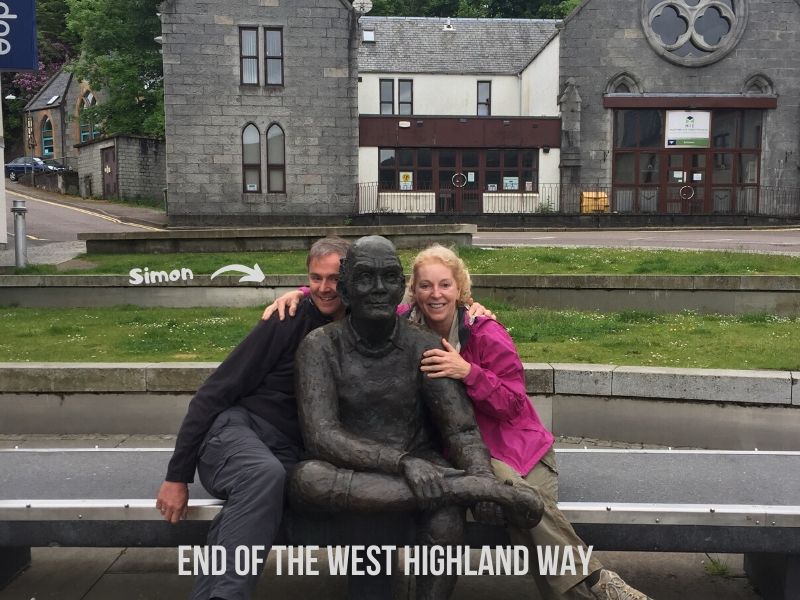
The trail ends in the heart of town on the pedestrian main road at the sore feet bronze statue designed by David A Annand. Another tip-off of Scottish sensibilities and humor, you can see my smiling face sitting next to Mr. Sore Feet at the website. Many hikers add to their hike a climb of Ben Nevis, the UK’s highest peak at over 4,400 feet which is in Fort William. I’m still a bit concerned about my knee so I choose a different path. I met up again with my new hiking friend, Simon and we had dinner the night I arrived in Fort William. The next day after a coffee with Simon, I’m still a bit concerned about my knee. I chose a different path. I ended up taking the famous scenic train ride to Mallaig. This is a picture postcard beautiful perfect ride. You take this extraordinarily beautiful train ride to Mallaig, have lunch, visit the museum to learn about the town’s history and its importance as western Scotland's most important commercial fishing port, walk around a bit and take a train back.
While I was there, I found an Outfitters so I was able to buy a pair of waterproof gloves. You can also take a historic steam train up there. It’s the same view and it’s the regular train so it just cost a little bit more. I took the regular one. Jamie and his friends arrived the next day. It was so cool to hang out with his friends and they didn’t seem to mind that I was an old lady. Granted they’re young enough to be my kids, but they seemed cool having me around. Jamie’s mom, Carol, also came too so I wasn’t the only one of a certain age. We were at a large party. It was hard to find a restaurant to take us to dinner without reservations so we ended up at this Chinese restaurant that had no customers, which made us a little bit nervous as all of the other restaurants were packed. Gratefully, everything went well and happily. There had been many customers before we left. I had been worried about food turnover and sanitation issues, etc. I’m happy to report that no one got sick and we all enjoyed our meal.
The next day was the big hike for Jamie’s birthday. We took a train to the mountain for our climb. The weather that day was as pleasant as my clawed hand day. It was bitter raw cold awful piercing rain with about ten feet of visibility. I was so grateful for my new waterproof gloves because I was fine even though the weather was miserable. My mom always told me that if you have the right clothes, it doesn’t make a difference what the weather is. She is right. The funny thing about adventure travel is that when you look back, it’s the things that didn’t go well that you remember most fondly. I think about how I couldn’t hold toilet paper that morning. My hands were frozen, but I notice that I am smiling when I think about it or I tell the story. I think about climbing Mount Munro for Jamie’s birthday when we were pretty much in whiteout conditions and unable to see a few feet in front of ourselves in this bitter cold piercing rain. We only pause briefly at the summit for a quick photo op before racing back down to get into some heat. It was one of the highlights of our trip. I was blessed with good weather on most of my trip except for the two days I just mentioned.
Back To Fort William
I find that it’s overcoming the obstacles and persevering that I remember most and that I remember most fondly. Overcoming obstacles seems to make me proud of myself and I seem to enjoy pushing myself. When we’re back down the mountain, we’re now safely warm with soup in our bellies while we waited for the train back to Fort Williams. We were laughing in the cold and the rain. We cheered our endurance. We relished reliving the misery. On any adventure trip I take when I look back, it’s the things that went wrong or the most difficult challenges that set the adventure apart from others and that’s where the memories come from. When I look back on this adventure, I smile more about that clawed hand than I do about the perfect view on the top of Conic Hill. I think it must do with us pushing ourselves, enduring the challenges and then triumphing over them.
People who choose to do adventure travel for their vacations are different than most people. We seem to have this odd pat ourselves on the back for overcoming the challenges mentality. We seemed to thrive on it a little bit. We get dirty and sweaty and are often uncomfortable and sometimes in a little pain. My family and friends sometimes don’t understand why I’m doing this. Some friends are envious, but they wouldn’t do it themselves. If you are reading this, I’m betting that you are one of my people and you get it. I’m so glad you do.
My takeaway of hiking the West Highland Way in Scotland is that this is a very doable hike for almost anyone in good shape. You can do it self-guided as I did it, you can plan your own adventure and even backpack the trip like Simon did. Although when he heard about how I had my luggage transferred, he wished he had done that. The West Highland Way is a very popular trail and the accommodations in these small villages are limited so you need to plan well in advance. Be sure to download the free West Highland Way cheatsheet that you can find on the website. You’ll get it automatically if you subscribe to the newsletter and in that way, you can either file it in your computer or print it out and have a little dream bucket list book.
If you haven’t done so already, please subscribe to the Active Travel Adventures podcast. If you don’t know how to, you can visit any of my webpages to find the link that will show you how. If you have subscribed, thank you. You’re one of the early adopters of this podcast technology. Most people don’t even know what a podcast is. Could you please do me a favor and honor of grabbing a friend’s phone and subscribing them to Active Travel Adventures so you can enlighten them on this cool new tool called a podcast. At any time, please feel free to email me at Kit@ActiveTravelAdventures.com. I love hearing from you, I like to hear your suggestions, your comments and destinations. Let’s keep in touch. Until next time. Adventure on.
Â
Important Links:
- Kit@ActiveTravelAdventures.com
- West Highland Way
- MikesRoadTrip.com
- Episode number one – previous episode